

Loading...
Loading Calculator...
Calculate Body Mass Index (BMI) with personalized health insights, ideal weight range, and calorie recommendations
Loading calculator...
Explore our other professional calculators
Add this calculator to your website with just a few lines of code. Fully customizable, secure, and mobile-friendly.
Home • Calculators • About • Methodology • Contact
💡 Get More Personalized Insights
For a comprehensive health assessment, consider adding age, gender, waist circumference to unlock detailed body composition analysis, cardiovascular risk assessment, and personalized calorie recommendations based on your activity level.
Body Mass Index (BMI) is calculated by dividing your weight in kilograms by the square of your height in meters (kg/m²). It was developed by Belgian statistician Adolphe Quetelet in the 1830s and adopted by the World Health Organization in the 1990s as a simple, cost-effective screening tool for weight categories.
BMI categories are based on extensive population studies correlating body weight with health outcomes, particularly cardiovascular disease, diabetes, and mortality risk.
BMI doesn't distinguish between muscle and fat mass. Athletes and bodybuilders may have high BMI due to muscle, not excess fat. Similarly, older adults may have normal BMI but low muscle mass and higher body fat.
BMI also doesn't account for fat distribution. Waist circumference and waist-to-height ratio are better predictors of cardiovascular risk, which is why we include these measurements when available.
Who BMI may not suit: Pregnant women, children under 18 (requires age-specific percentiles), elite athletes, elderly individuals, and people with certain medical conditions.
Example: For a person weighing 70 kg and height 1.75 m:
BMI = 70 ÷ (1.75 × 1.75) = 70 ÷ 3.06 = 22.9
Example: For a person weighing 154 lbs and height 68 inches (5'8"):
BMI = (154 ÷ 4,624) × 703 = 23.4
Find your height and weight to see your BMI category. The chart supports both metric and imperial units.
Open the full interactive BMI height-weight chart in a new window to print or save for reference. Available in both metric (kg/cm) and imperial (lbs/inches) units.
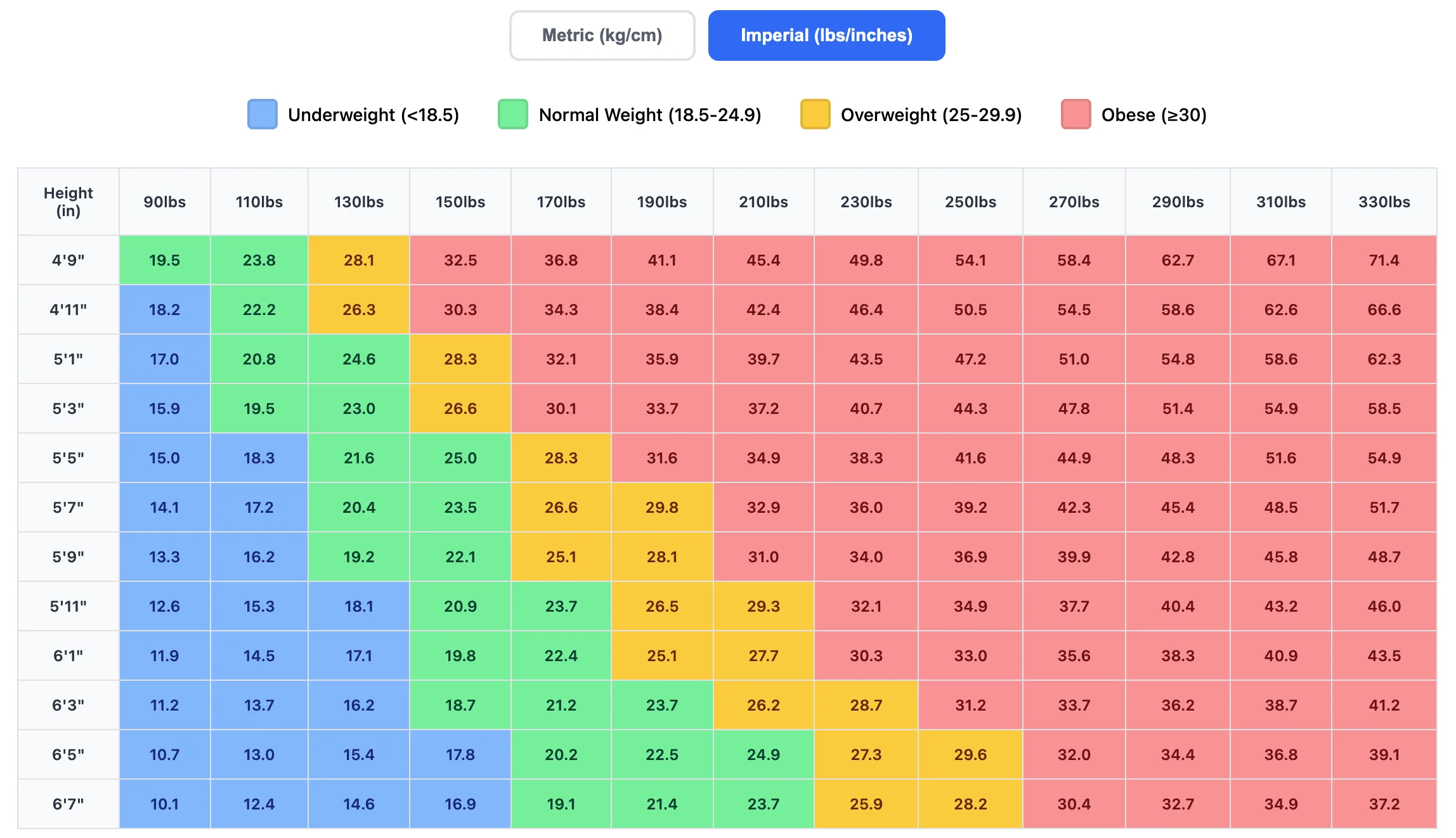
For full category definitions and population-specific guidance, see the "BMI Guidelines for Different Populations" section below.
| Category | BMI Range | Health Risk |
|---|---|---|
| Underweight | < 18.5 | Increased |
| Normal Weight | 18.5 - 24.9 | Lowest |
| Overweight | 25.0 - 29.9 | Increased |
| Obese Class I | 30.0 - 34.9 | High |
| Obese Class II | 35.0 - 39.9 | Very High |
| Obese Class III | ≥ 40.0 | Extremely High |
Applies to: India, Japan, Singapore, Hong Kong, China, and other Asian countries
| Category | BMI Range | Health Risk |
|---|---|---|
| Underweight | < 18.5 | Increased |
| Normal Weight | 18.5 - 22.9 | Lowest |
| Overweight | 23.0 - 24.9 | Moderate |
| Obese Class I | 25.0 - 29.9 | High |
| Obese Class II | ≥ 30.0 | Very High |
Why lower thresholds? Research shows Asian populations have higher body fat percentage and greater cardiovascular risk at lower BMI values compared to European populations.
BMI for children is calculated the same way but must be plotted on CDC or WHO growth charts that compare BMI to other children of the same age and sex (BMI-for-age percentiles).This calculator is not designed for children.
Excess weight is associated with increased risk of:
Good news: Even modest weight loss (5-10% of body weight) can significantly reduce these risks.
Being underweight may indicate or lead to:
Maintaining a healthy BMI is associated with:
This BMI calculator is for informational and educational purposes only. It is not a substitute for professional medical advice, diagnosis, or treatment. BMI is a screening tool that estimates weight category based on height and weight, but it does not directly measure body fat or assess individual health status.
Always seek the advice of your physician, dietitian, or other qualified health provider with any questions you may have regarding your weight, health conditions, or medical treatment. Never disregard professional medical advice or delay seeking it because of information from this calculator.
If you think you may have a medical emergency, call your doctor or emergency services immediately.
Senior Data Scientist
Credentials: PhD Mathematics, M.Sc Statistics
Dr. Sharma holds a PhD in Applied Mathematics from IIT Delhi and specializes in computational algorithms. She reviews all scientific and mathematical calculators for accuracy using international IEEE standards.
This calculator has been verified for accuracy by our team of experts and is reviewed monthly to ensure compliance with current regulations and industry standards.